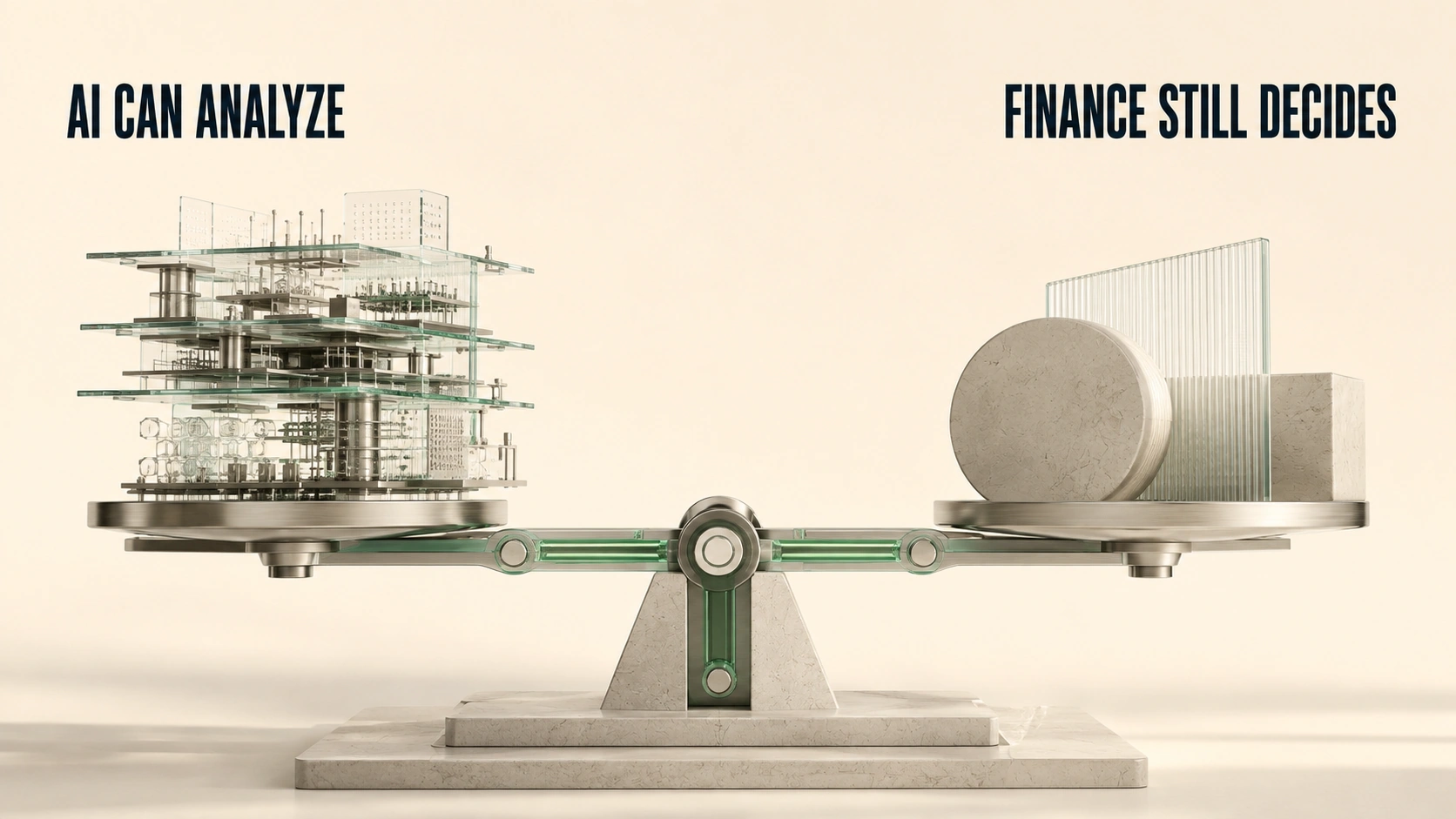
- AI can automate a large part of financial analysis, including variance analysis, anomaly detection, recurring reporting, and investigation of financial movements.
- The best place to start is with repetitive analytical work that follows a clear process and consumes significant finance-team time.
- AI becomes more useful when it can examine financial data alongside the operational drivers behind the numbers.
- Governed data gives AI the consistent definitions, reliable sources, and business context needed for trustworthy analysis.
- Financial judgement remains essential when findings require strategic context, assumptions, trade-offs, or a decision about how the business should respond.
- Agentic Analytics can continuously monitor business data, investigate meaningful changes, and surface analysis for finance to review.
- xP&A connects those findings to financial and operational plans across the organization.
- The strongest model brings data, AI, and people together: data provides the foundation, AI handles more of the analytical workload, and finance professionals apply judgement and accountability.
- AI in FP&A should give finance more capacity for judgement, rather than trying to remove judgement from the process.
AI can take over a large part of financial analysis. It can work through volumes of data that would take a finance team hours to review, spot changes that deserve attention, trace variances back to their drivers, and bring relevant information together for a forecast or decision.
What it cannot provide on its own is the judgement that comes from understanding the business behind those numbers.
The future of AI in FP&A therefore depends on getting the relationship between data, AI, and people right. Trusted data gives AI a reliable foundation. AI takes on more of the analytical workload. Finance keeps the judgement, accountability, and authority to decide what the findings mean.
That distinction becomes important as finance teams start looking beyond automation for its own sake. The real opportunity is to change where financial professionals spend their time.
Start With the Work Finance Actually Does
A monthly forecast review contains plenty of work that has little to do with making the final decision.
Someone pulls actuals. Another report is brought in for comparison. Variances are sorted by department, account, product, or geography. Large movements are investigated. Finance reaches out to business teams for explanations. The information is brought together before anyone can have a useful conversation about the outlook.
Much of this requires financial expertise. Much of it also follows a repeatable process. The same questions come up every month:
- Where did we miss?
- Which costs moved?
- What changed from the previous forecast?
- Which business unit is driving the variance?
- Which assumptions are now looking different?
That makes financial analysis a natural place for AI to take on more of the workload.
A finance professional should not have to spend most of the review cycle finding the interesting part. The interesting part should already be there.
The First Opportunity Is Finding What Matters
Financial data contains an enormous amount of movement.
A good AI system can examine actuals, forecasts, historical patterns, targets, and relevant business drivers to identify changes that warrant investigation.
That could be a margin movement in one product category, an unexpected change in customer acquisition costs, a shift in working capital, or a revenue variance concentrated in a particular segment.
The useful part is the filtering. Finance needs help separating ordinary movement from something that could alter the financial picture.
That changes the starting point for the analyst. Instead of opening a report and searching through hundreds of lines for something unusual, the analyst can begin with the areas that have already been identified as worthy of attention.
Then Comes the Investigation
Suppose gross margin is below forecast. There could be several reasons:
- Product mix may have shifted
- Discounting may have increased
- Supplier costs could have risen
- A particular region might be carrying higher fulfilment costs
An analyst can work through those possibilities manually. AI can perform much of the initial investigation by examining the dimensions and business drivers behind the movement.
It can identify where the variance is concentrated and bring related information into the same analysis. The finance team gets a much faster route from the headline number to the areas that need closer examination.
This is where the quality of the underlying data becomes critical. If product definitions differ between systems or revenue is calculated differently by different teams, the analysis has a weak foundation regardless of how sophisticated the AI is.
AI doesn't remove the need for data discipline. It makes that discipline more important.
Data Comes Before AI
AI is only as reliable as the business information it can work with.
A finance team may have a trusted revenue figure but still lack a consistent view of the operational drivers behind it. Customer data may sit in one system, sales activity in another, and planning assumptions somewhere else.
If those pieces cannot be understood together, AI has limited context for its analysis.
This is where governed data becomes foundational. Finance needs consistent definitions, clear ownership, reliable sources, and enough lineage to understand where important figures came from. The AI needs the same foundation if it is going to investigate financial performance rather than simply describe changes in a dataset.
Data provides the ground AI stands on. The better that foundation, the more useful the analysis can become.
Financial Judgment Begins Where the Data Stops
Now consider a different situation.
AI identifies a sharp increase in customer acquisition cost. The movement is real. It is significant. The system can show where the increase occurred and how it compares with previous periods.
Should finance recommend reducing marketing spend? That is a different question.
Perhaps the company deliberately increased investment to enter a new market. The higher acquisition cost may be expected while the new channel develops. Cutting the spend immediately could undermine the strategy.
The numbers alone cannot settle that decision. Someone needs to understand the commercial context, the original investment thesis, the assumptions behind the plan, and the alternatives available to the business. That is where financial judgement comes in.
A finance professional's time can go toward evaluating the evidence and deciding what it means in the context of the business.
The Boundary Should Be Deliberate
This is one of the most important questions for a CFO considering AI in FP&A. Where should the machine stop?
Where Automation Makes Sense
- Finding material variances
- Comparing actuals with forecasts
- Detecting unusual movements
- Investigating contributing factors
- Monitoring planning assumptions
- Preparing recurring analysis
- Identifying relationships across financial and operational data
- Generating an initial explanation for a movement
Where Finance Stays in Charge
- Deciding whether an explanation is credible
- Choosing between competing scenarios
- Understanding strategic trade-offs
- Challenging assumptions
- Approving changes to the forecast
- Communicating implications to leadership
Those responsibilities require context and accountability. A sensible AI strategy doesn't blur that line. It makes the line clearer.
The Finance Team Should Get More Time for the Difficult Questions
This is where automation starts to create value beyond efficiency.
If an FP&A team spends fewer hours preparing variance analysis, it can spend more time asking whether the assumptions behind the forecast still make sense.
If AI can investigate a movement before the meeting begins, finance can use the meeting to discuss what should happen next.
The nature of the work changes. The analytical preparation becomes more automated. The judgement becomes more important. That is a better use of a finance team's expertise.
Analysis Can Become Continuous
The same model works beyond the monthly close.
Business conditions change between forecast cycles. A customer segment behaves differently. Conversion drops. Costs begin rising. Pipeline quality shifts.
Waiting for the next scheduled review means the finance team may discover the change after it has already affected the outlook.
Agentic Analytics can continuously examine governed business data and surface changes that may deserve financial attention. Finance can then decide whether the movement warrants investigation, a scenario, or a change to the forecast.
The system is working continuously. The financial team remains in control of what happens with the result. This is the same idea we cover in How Can Finance Update Forecasts When Business Conditions Change Mid-Quarter?
The Analysis Also Needs a Place to Go
A change in revenue can affect hiring. A margin issue can lead to pricing discussions. A demand shift can affect inventory and operations. A change in customer behaviour may alter marketing plans.
The insight needs to travel. This is where xP&A completes the picture. Extended Planning & Analysis connects financial planning with the operational plans across the business.
When AI surfaces a meaningful change, finance can examine its financial implications alongside the plans that may be affected elsewhere.
Governed Data
Gives the system a reliable foundation.
Agentic Analytics
Helps identify and investigate what is changing.
Extended Planning & Analysis
Connects those findings to planning.
People
Bring the judgement to decide what the organization should actually do.
The four parts reinforce each other.
AI Should Increase the Capacity for Judgment
The strongest case for AI in FP&A is that finance can spend less of its time doing work that machines are increasingly capable of handling:
- Finding the variance
- Tracing the movement
- Gathering the supporting data
- Comparing the current position with historical patterns and forecast assumptions
Those activities can consume enormous amounts of time without being where the highest-value financial judgement happens.
Give more of that work to AI, and the role of finance becomes more valuable rather than less. The team has more time to challenge the plan, test scenarios, understand trade-offs, and help the business decide.
The Future of FP&A Needs All Three
There is no single technology that solves the problem.
AI without reliable data has limited value. Reliable data without useful analysis leaves finance doing much of the work manually. Analysis without human judgement can produce findings without understanding the business consequences.
The three need to work together. Governed data gives AI a trusted foundation. Agentic Analytics takes on more of the analytical workload and keeps looking for meaningful changes. Finance professionals bring the judgement, context, and accountability that turn those findings into decisions. xP&A then connects those decisions to the plans across the business.
That is a more useful vision for AI in FP&A. The objective is to remove as much unnecessary work around that judgement as possible.
AI can automate more of financial analysis without replacing financial judgement when data, AI, and people are designed to work together. The machine handles more of the investigation. Finance gets more time to decide what the business should do with what it finds.