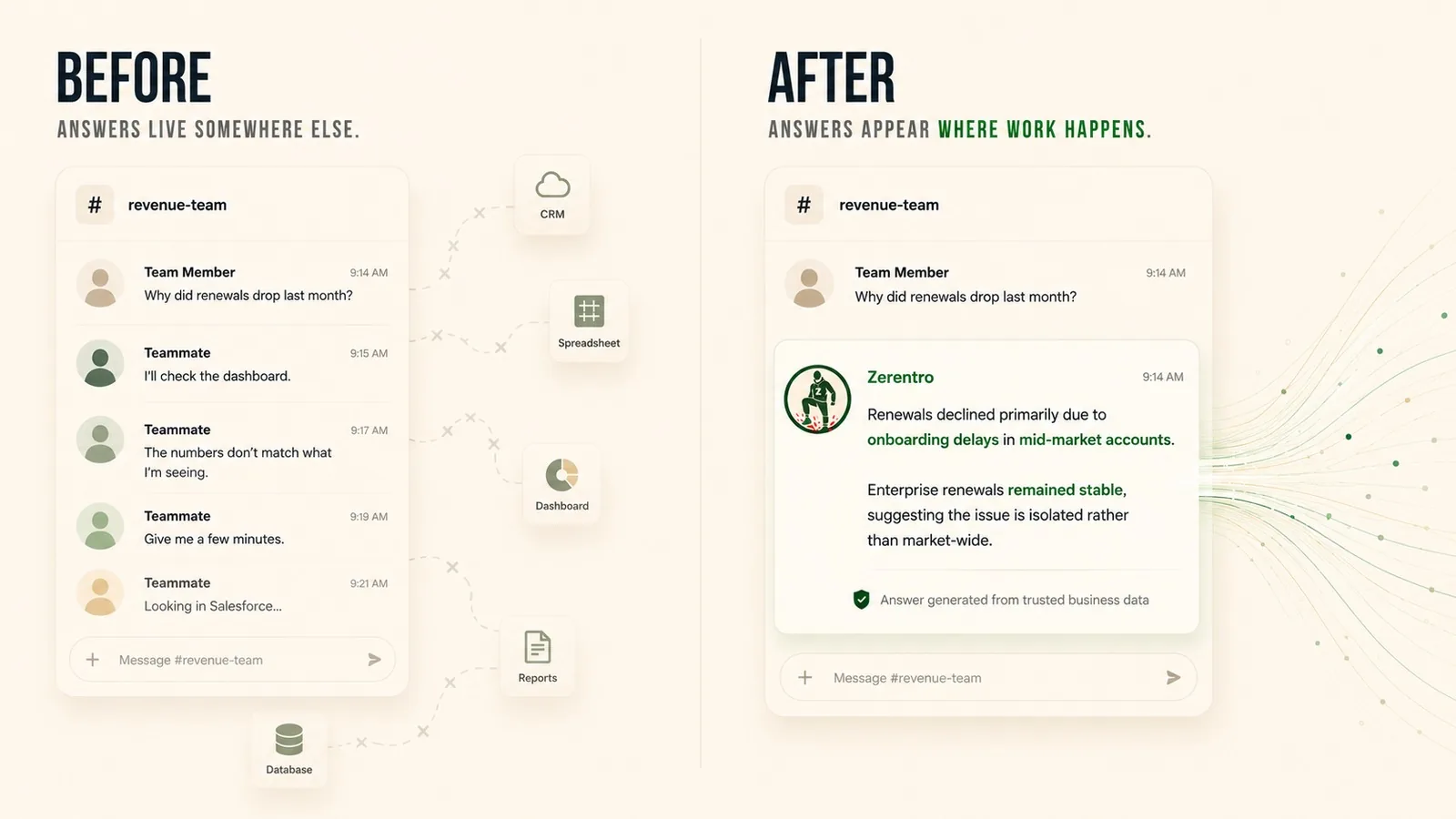
- Most business questions arise during conversations.
- Dashboards provide visibility but often interrupt the flow of decision-making.
- As organizations grow, finding answers becomes more difficult despite having more data.
- AI is shortening the gap between questions and answers.
- The future of business intelligence is bringing trusted information closer to where work already happens.
Business questions rarely begin inside analytics platforms, they begin where work happens.
The closer trusted information is to those conversations, the easier it becomes to understand what is happening, ask better questions, and make better decisions.
As organizations grow, creating that experience becomes more difficult.
The rest of the challenge is understanding why.
The Distance Between Questions and Answers
Have you ever noticed what happens when someone asks a question during a meeting?
Not a big strategic question. Something simple like "Why did renewals drop last month?" or "Are enterprise customers converting better than mid-market?" or "Did the new pricing change improve margins?"
Most of the time, nobody expects these questions to be difficult.
The answer should already exist somewhere.
Then the search begins. One person opens a dashboard and someone else checks a spreadsheet. A third person promises to pull the numbers after the meeting. Five minutes later, the discussion drifted somewhere else. A few days later, a report gets shared.
Sometimes the original question is answered. Sometimes it isn't. And this happens inside organizations every day. The strange part is that it happens despite companies having more data than ever before.
The question is asked
"Why did renewals drop last month?" Nobody expects it to be difficult.
The search begins
One person opens a dashboard. Someone else checks a spreadsheet. A third promises to pull numbers after the meeting.
The conversation drifts
Five minutes later, the discussion has moved on. A few days later, a report gets shared.
The question fades
Sometimes it is answered. Sometimes it isn't. Either way, the moment for action has passed.
Dashboards Solved One Problem. Then the Nature of Work Changed.
For years, the goal was simple. Make information accessible by building dashboards, creating reports, and tracking key metrics. And to be fair, this worked.
Teams gained visibility they didn't have before and leaders could monitor performance more easily.
Important numbers became easier to find, but something interesting happened along the way.
The amount of information available increased dramatically and the number of questions people needed answered increased even faster.
A dashboard can tell you what metrics exist. It cannot predict the next question someone is about to ask. Real business conversations rarely follow a predefined path.
One question leads to another and most dashboards were never designed for that kind of interaction.
Nobody Goes Looking for Data
They're looking for answers. People don't wake up in the morning excited to open a dashboard. They open dashboards because they're trying to understand something.
The dashboard is simply one stop along the way. They're trying to understand what happened.
When a leadership team reviews performance, they are not searching for data points, they're deciding what needs attention and data is part of that process. It is rarely the destination.
Work Doesn't Happen Inside Analytics Tools
Think about where decisions actually get made. They are usually planning sessions, leadership reviews, customer meetings, project discussions, weekly team check-ins and strategy conversations.
Work happens wherever people are collaborating. Yet in many organizations, the information needed to support those conversations lives somewhere else and people leave the discussion to go find answers. Resulting in the momentum disappearing and questions get parked for later.
In some cases, the question simply fades away because answering it requires more effort than anyone can spare at that moment.
The result is lost opportunities to learn, adapt, and make better decisions.
Why This Becomes Harder as Companies Grow
Small teams can often work around these problems as the same people attend every meeting. Everyone has a similar understanding of what's happening.
But growth changes that. More teams get involved. Different departments start measuring success in different ways and it becomes more complicated.
A question that once required a quick conversation may now require information from finance, sales, marketing, and operations.
The answer still exists but reaching it becomes harder. This is one of the reasons growing organizations often feel less aligned than smaller ones, even when they have access to far more information.
AI Is Changing the Relationship Between Questions and Answers
For a long time, there was a gap between curiosity and understanding.
Someone had a question, someone else had to investigate and the answer arrived later.
Recent advances in AI are beginning to shorten that gap as questions can be explored while conversations are still happening.
People can dig deeper without waiting for reports to be built and follow-up questions become part of the process rather than the start of another request.
The technology itself is interesting but the bigger shift is what it does to the flow of work. People spend less time searching and more time thinking, discussing implications and deciding what to do next.
Access Matters. Trust Matters More.
Making data easier to reach solves part of the problem and the information also has to be trusted. Most organizations have experienced the frustration of seeing different numbers in different places.
The conversation shifts away from decisions and toward figuring out which number is correct. When that happens often enough, confidence starts to disappear. Bringing data closer to where work happens only works when everyone is working from the same foundation.
The Future of Data Is Closer to the Conversation
For years, organizations focused on helping people find data, the next step is helping data find people. By making trusted answers available where work is already happening, because business questions rarely begin inside analytics platforms. They begin in conversations.
And the closer answers are to those conversations, the more valuable they become.