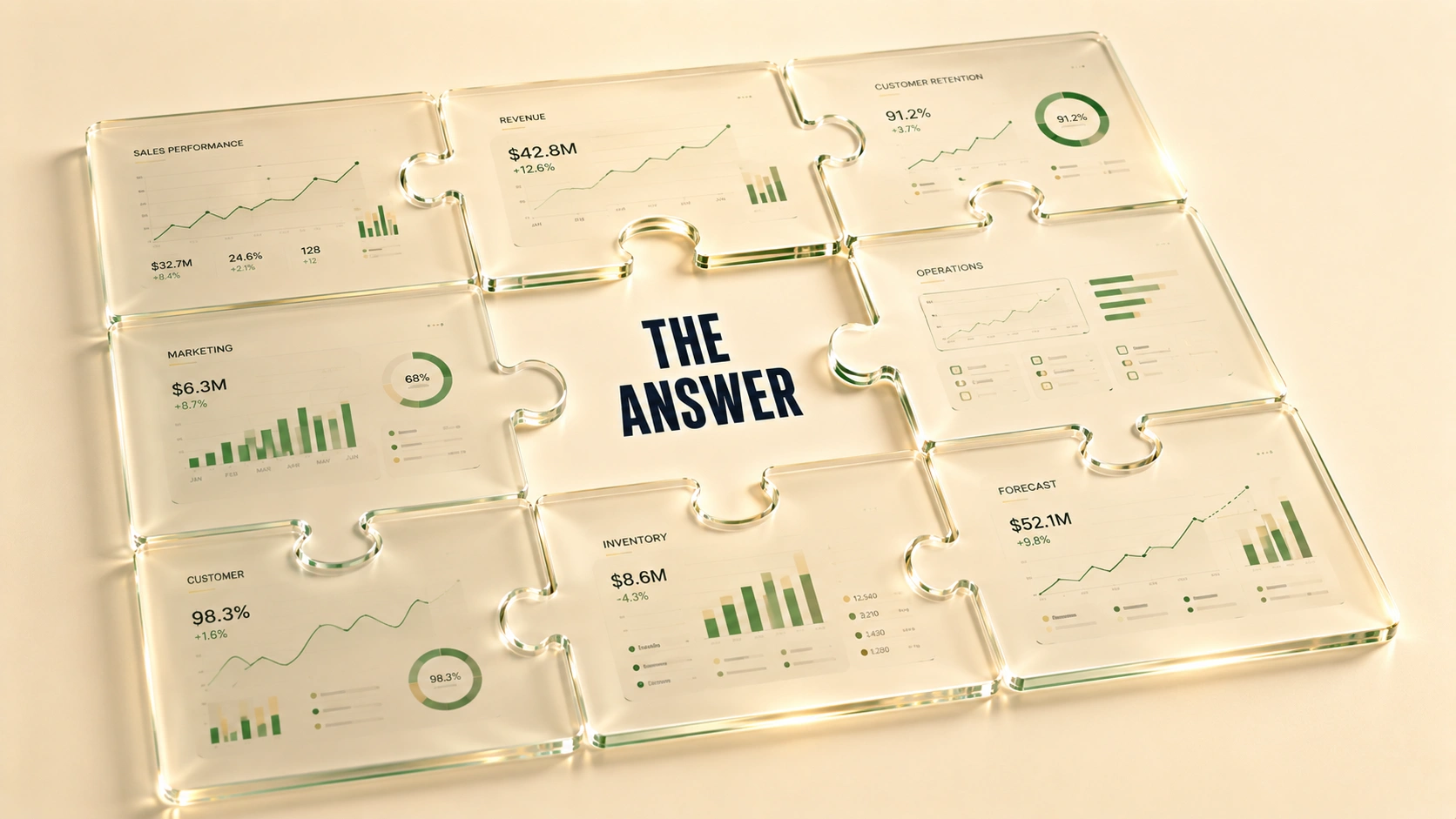
- Self-service BI made business data more accessible by reducing dependence on analytics teams.
- Access to dashboards did not always make it easier for people to find the answers they needed.
- As organizations grew, more reports and systems made business questions harder to answer.
- AI assistants are changing data access by allowing people to interact with information through natural conversations.
- Trusted, well-governed data remains essential for delivering reliable business answers.
- Solving this takes governed data, fast analysis and business context working together, not as separate tools.
Self-service business intelligence changed the way organizations accessed data.
It reduced dependence on analytics teams, gave business users greater visibility and made reporting more accessible across the organization.
Those were important improvements.
Yet many organizations found themselves in a familiar position a few years later. People were still waiting for answers.
The dashboards existed. The reports existed. The data existed.
The challenge was that making information available did not always make it easy to use.
Most business users were never looking for dashboards. They were looking for answers.
Self-Service BI Solved an Important Problem
For a long time, business teams depended heavily on analysts.
A sales leader wanted to understand pipeline performance. Finance needed a profitability report. Marketing wanted campaign analysis.
Most requests entered the same queue. Analysts gathered information, built reports and shared the results once the work was complete.
As organizations grew, this process became increasingly difficult to maintain. Business questions were growing faster than reporting teams could respond.
Self-service BI addressed that challenge. Business users gained direct access to information and teams could explore performance without waiting for every report to be created for them.
For many organizations, this represented a significant step forward.
Access Didn't Always Lead to Understanding
Making data available and making it easy to understand are not always the same thing.
Business questions rarely begin with a dashboard. They usually begin during a conversation.
A discussion about declining revenue quickly moves to customer retention. Customer retention leads to product adoption. Product adoption leads to support experience. Each question creates another.
Very few conversations follow the structure of a predefined report.
Many employees also found themselves working with information outside their own area of expertise. Understanding a dashboard often required knowing how metrics were defined, where the data came from and how different reports related to one another.
The information was available. Turning that information into an answer often required more effort than expected.
Complexity Continued to Grow
Organizations rarely become simpler over time.
New products are introduced. More departments contribute information and additional systems are added as the business expands.
Reporting grows alongside that complexity.
Sales builds dashboards around pipeline performance. Marketing tracks campaign results. Finance measures profitability. Operations monitors delivery and capacity.
Each report serves a purpose. The challenge appears when a business question spans several of them.
Many important decisions require information from multiple parts of the organization. Finding those connections often meant moving between reports, comparing numbers and interpreting different definitions before the discussion could continue.
Over time, many business users returned to a familiar habit. Instead of exploring every question themselves, they asked someone who already knew where to find the answer.
The Way People Access Information Is Beginning to Change
Recent advances in AI are changing how organizations interact with business data.
Instead of starting with a report, people can increasingly start with a question. Follow-up questions become part of the same conversation rather than the beginning of another search.
People spend less time navigating reporting tools and more time understanding what the information is telling them.
The shift is not away from business intelligence. It is toward a more natural way of accessing it. We explore this shift in more detail in How AI Assistants Are Changing Data Analytics.
Trusted Information Still Matters
Making information easier to access raises another expectation. People expect the answers to be consistent.
Most organizations have experienced situations where different reports produce different numbers or departments use different definitions for the same metric.
Those challenges do not disappear because an AI assistant provides the answer.
Reliable answers still depend on reliable data. A trusted foundation allows people to spend less time validating information and more time discussing what it means for the business.
Self-Service BI's Real Failure Point
Self-service BI failed because access was treated as the finish line.
Handing someone a dashboard and calling that self-service assumes the hard part is done. It isn't. The hard part is knowing which number to trust, understanding what changed it, and deciding what to do next. A dashboard can't do any of that on its own, and neither can a chat window bolted onto the same ungoverned data underneath it.
Swapping a dashboard for a conversational AI assistant just makes the same underlying gaps faster to reach.
Closing that gap for good takes three things working as one system, not three separate tools a team has to stitch together themselves:
Governed Data
So every number traces back to one trusted source instead of the sales dashboard, the finance sheet and the marketing report each telling a different story.
Agentic Analytics
So a question can be asked in plain English and answered instantly, with the reasoning shown, not just a chart to interpret.
Extended Planning and Analysis
So someone with business context is behind every answer, framing what it means and what to do about it, not just handing over a number. See What Is Extended Planning & Analysis (xP&A)? for how that team fits into the wider planning picture.
This is the model Zerentro is built on.
Remove any one piece and the old problem comes back in a new shape.
Looking Ahead
Self-service BI played an important role in making business information more accessible. Many organizations would not have the visibility they have today without it.
The challenge was never the technology itself. The expectation was that people would adapt to the technology.
Business has continued to evolve. Questions move quickly. Conversations move quickly. Decisions are expected to move just as quickly.
The way people access information is beginning to evolve alongside them, but only where governed data, instant analysis and business context are working together rather than living in separate tools.
Organizations are moving from navigating dashboards to asking questions. That change does not replace business intelligence. It builds on everything business intelligence has already made possible.