- More data does not automatically lead to better decisions.
- As organizations grow, information becomes fragmented across systems and teams.
- This creates an "insight gap" between available information and actionable understanding.
- AI helps organizations access and analyze information faster.
- XP&A connects insights to planning and execution.
- Businesses that unify data, analysis, and planning can make decisions with greater confidence and speed.
The next generation of business performance will not be defined by who collects the most data. Most companies already have more data than they can effectively use. The advantage will come from reducing the distance between information and action.
Most companies already have more data than they can effectively use. Yet answering important business questions often remains surprisingly difficult.
Information exists across systems. Knowledge exists across teams. Expertise exists throughout the organization.
As businesses grow, connecting those pieces becomes harder.
The organizations that create an advantage are the ones that can consistently turn information into understanding and understanding into action.
The challenge rarely appears overnight. It develops gradually as organizations grow.
A growing company rarely notices when information starts becoming harder to use and that change happens gradually.
A sales dashboard gets created for one team. Marketing builds its own reporting. Finance maintains a forecasting model. Operations tracks performance in a separate system.
Each addition makes sense, every new report solves a real problem and each new tool provides another layer of visibility.
A year later, the company has more information than ever and less confidence in what it all means.
A simple question starts requiring multiple meetings.
Teams arrive with different numbers.
Leadership spends time validating information before discussing decisions.
Nothing is broken.
The organization has simply become more complex than the systems supporting it and what starts as a visibility problem eventually becomes a decision-making problem.
Each team builds its own layer
Sales dashboard. Marketing reporting. Finance forecasting model. Operations tracking — all separate.
More information, less confidence
A year later, the company has more information than ever and less confidence in what it all means.
Simple questions require multiple meetings
Teams arrive with different numbers. Leadership spends time validating before discussing decisions.
Visibility problem becomes a decision-making problem
The organization has simply become more complex than the systems supporting it.
More Data Doesn't Automatically Create More Clarity
Most organizations are producing data at an unprecedented scale. Every customer interaction, transaction, campaign, support ticket, and operational process leaves behind a digital trail. Collecting information is no longer the challenge it once was.
Making sense of it is a different story. Many leaders have experienced the same situation.
A board meeting is approaching. Revenue numbers look healthy. Customer acquisition appears strong. Product usage is growing.
Then someone asks a straightforward question.
Which growth initiatives are generating the highest long-term value?
The room becomes quiet.
The answer exists somewhere.
Part of it sits in a CRM. Part of it lives inside marketing platforms. Some of it is buried in financial reports. Another piece may be hidden in operational systems.
Finding the answer becomes an exercise in gathering information rather than making a decision.
The issue is that valuable context has become scattered across the organization.
Complexity Has a Way of Accumulating
Organizations naturally become more specialized as they grow.
Sales focuses on pipelines. Marketing focuses on demand generation. Finance focuses on forecasting and profitability. Operations focuses on execution and efficiency.
Each team develops its own processes, metrics, and reporting structures. This specialization creates expertise and it also creates distance.
Over time, different departments begin viewing the business through different lenses.
A metric that appears straightforward on the surface may be defined differently across teams.
A report created for one purpose starts being used for another.
The organization keeps moving forward, but understanding becomes fragmented.
Most leaders recognize this feeling that the information exists but alignment becomes harder to find.
When Information Moves Slower Than the Business
Modern businesses are expected to make decisions quickly, yet many organizations still rely on processes that were designed for a slower environment.
By the time information is collected, consolidated, reviewed, and distributed, the business has already moved forward.
Resulting in teams working from snapshots of reality rather than the current picture and this creates friction as decisions take longer and priorities become harder to align. Opportunities remain unexplored because the information needed to evaluate them arrives too late.
Speed is often discussed as a competitive advantage but in practice, speed is usually a byproduct of clarity. Organizations move faster when they can understand what is happening without navigating layers of complexity first.
Reporting Creates Visibility
Most companies have reporting and dashboards. Some have entire teams dedicated to producing performance updates.
But the real challenge begins after the report is delivered.
A chart may show declining conversion rates. A forecast may reveal a gap between targets and expected performance. An operational report may highlight growing inefficiencies.
These findings create awareness but the next set of questions is where real value emerges.
Why is this happening? What changed? What happens if the trend continues? Which actions will have the greatest impact?
Answering these questions often requires combining information from multiple parts of the business. It requires context, interpretation and connecting signals that rarely exist in a single report.
This is where analysis becomes more important. The good news is that this is beginning to change.
Turning Information Into Insight
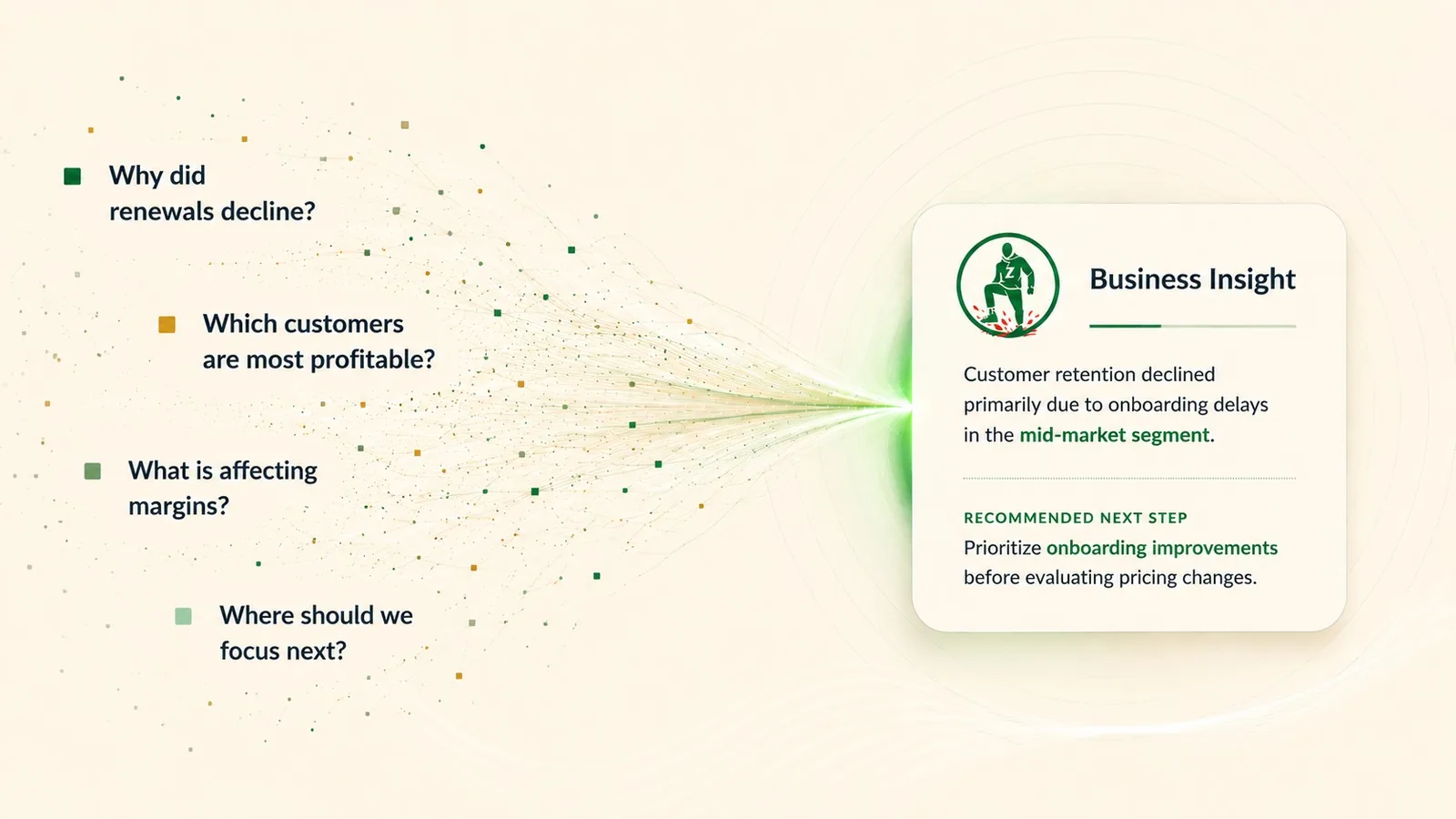
Recent advances in AI are changing how organizations interact with data. Questions that once required manual analysis can now be explored in minutes and information becomes more accessible to people outside traditional analytics teams.
This shift matters because business decisions rarely happen inside analytics departments. They happen during planning sessions, leadership reviews, customer discussions, and operational meetings. The people making decisions need answers at the moment.
Waiting days for analysis creates distance between insight and action.
When AI is combined with trusted business data, organizations gain the ability to explore questions naturally and receive meaningful responses quickly.
The conversation shifts from finding information to understanding implications and that shift is significant.
The Missing Link Between Insight and Action
Many organizations successfully improve reporting, some improve analysis and fewer improve decision-making.
The reason is simple.
A decision made in one part of the business rarely stays there for long.
A stronger sales pipeline may require additional hiring. A change in marketing spend can reshape financial projections. Capacity challenges often influence growth plans long before they appear in a report.
Every meaningful business decision creates ripple effects across the organization and understanding those connections requires more than visibility, it requires coordinated planning.
This is where Extended Planning and Analysis (XP&A) becomes increasingly important.
XP&A helps organizations bring planning, forecasting, and decision-making into a connected process. Teams gain a clearer view of how financial goals, operational realities, and strategic priorities influence one another, making it easier to evaluate decisions in a broader business context.
The result is greater alignment. Teams gain a clearer understanding of trade-offs. Leadership gains visibility into how decisions influence future outcomes and insight becomes part of planning rather than an isolated activity.
Closing the Insight Gap
Organizations rarely struggle because they lack information. The challenge is usually much more subtle.
Information exists in many places. Knowledge exists in many teams. Expertise exists across the organization.
Connecting those pieces consistently becomes harder as complexity grows.
Closing the insight gap requires bringing together three capabilities.
Each capability strengthens the others. Remove one and decision-making slows down.
Connect all three and organizations gain the ability to operate with greater confidence.
Organizations that can unify data, surface meaningful insights, and connect those insights to planning will be positioned to respond faster, adapt more effectively, and make better decisions over time.
In an increasingly complex environment, clarity becomes a competitive advantage and clarity begins with understanding.